Start Date: 2024-07-30
Total Days: 19
Total Drafts: 116,804
Total Games: 679,966
Win Rate: 54.7%
Mean Turns per Game: 8.89
Mean Games per Draft: 5.82Bloomburrow (BLB) Arena Draft Analysis
EDA
Draft
BLB
Arena
Draft set analysis for Bloomburrow
1 Introduction
Drafting in Magic: The Gathering (MTG) is a complex and dynamic format that challenges players to adapt quickly, make strategic decisions, and understand the evolving meta of each new set. In this analysis, we explore the Bloomburrow (BLB) set, which was released in Arena on July 30, 2024. We will investigate the effect of deck color choices on player win rates.
We use data from the 17Lands for the premier draft format on MTG Arena, a best-of-one draft format where players draft in a pool and play until they win 7 games or lose 3.
By examining deck performance aim to uncover the key elements that contribute to success in this draft environment. Through this analysis, we provide valuable insights to help both seasoned and new drafters make more strategic decisions in the Bloomburrow draft format and beyond.
To see other analyses of MTG draft data, check out the Draft Analysis page.
2 Summary Data
Here we summarize key statistics from the data, reflecting the experiences of 17Lands players.
3 Color Decks
We will explore the use and importance of colors in draft decks. We will look at the frequency of color sets in decks, the win rates of color sets, and the win rates of color pairs.
3.1 Color Frequency
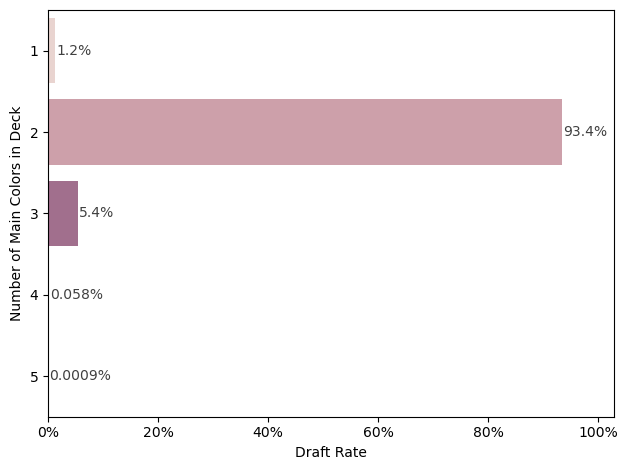
We start by examining the frequency of decks drafted for each color combination in Figure 1. The ten two-color decks are the most common, aligning with the design intent of Bloomburrow, which focuses on ten two-color animal tribes. Although the other sets, such as MKM, OTJ, and MH3 also are predominately two-color, the BLB set is >90% two-color, while the others are ~70% two-color.
Since two-color decks are the most common, we’ll focus on these pairings. In Figure 2, we see the most frequent drafted decks are Black-Green, White-Green, and Blue-GReen. On the other hand, the least drafted are Blue-Black, Blue-Red and White-Blue.
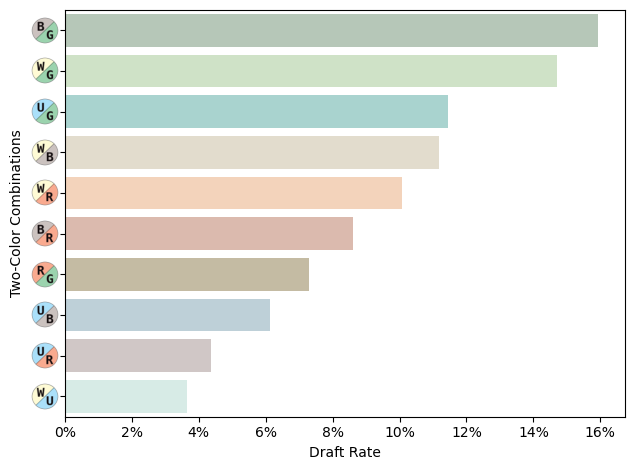
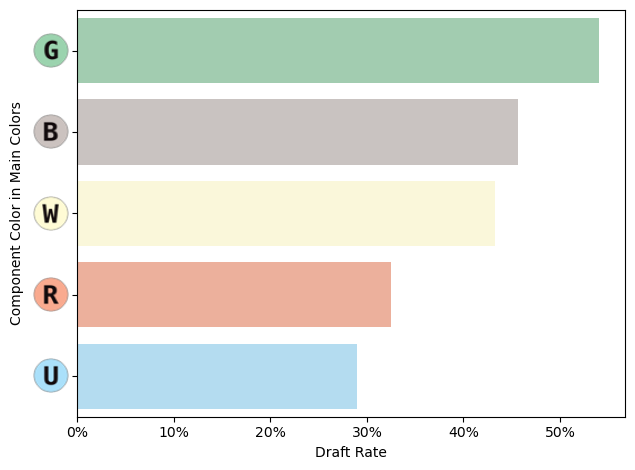
Figure 3 shows the color composition of the decks. Green stands out as the most frequently drafted color, with Black and White also being popular choices. In contrast, Red and Blue are drafted far less frequently.
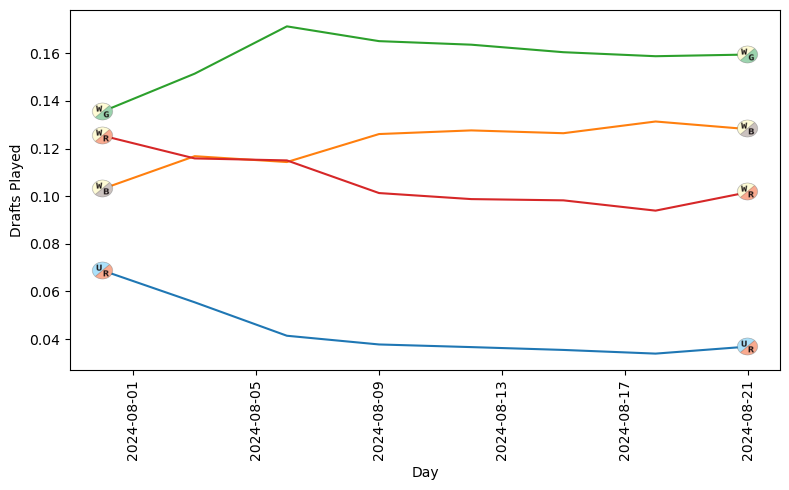
Next, we examine the four decks with the largest absolute changes in use between the start and end of the time period, shown in Figure 4. We see Blue-Green and White-Black increasing over time, while Red-Green and White-Red lose favor over time.
3.2 Color Win Rates
In addition to analyzing the use rates of the colors, we’ll also examine their win rates. First, we calculate the weighted average win rate, which is 54.60%. As highlighted in the summary section, this win rate suggests that the 17Lands player base performs better than the general draft player base.
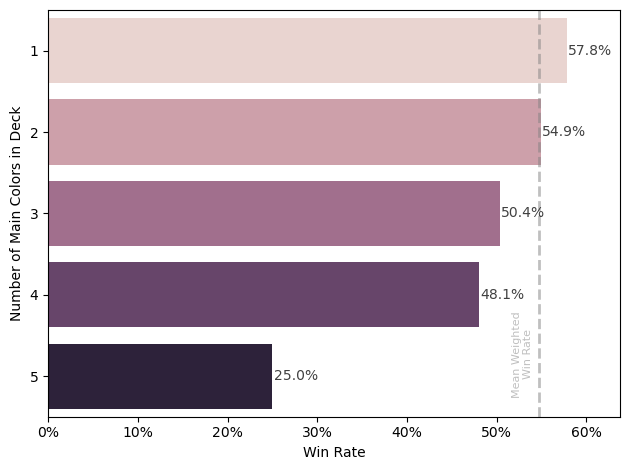
Figure 5 presents the win rates for each color combination. While some mono-color decks have notably high win rates, their low use rates suggest that these results may be circumstantial due to small sample sizes. OF the sets analyzed, BLB has the highest dispersion of win rates among the number of colors in the main deck.
In Figure 6, we focus on the 2-color decks. The Black-Red deck boasts the highest win rate, though it has a relatively low use rate. Meanwhile, the White-Red and Black-Green decks are the most popular and also maintain high win rates.
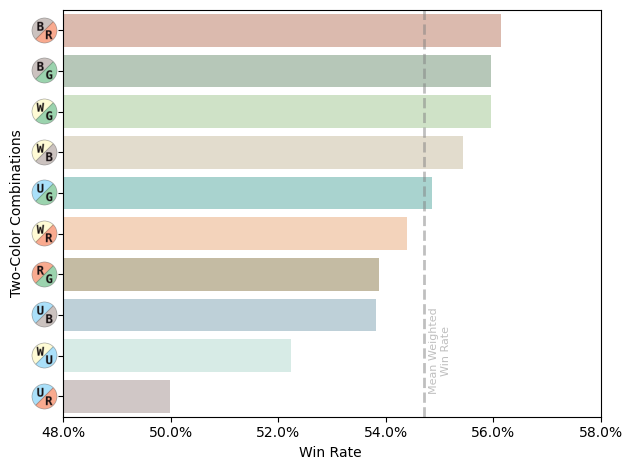
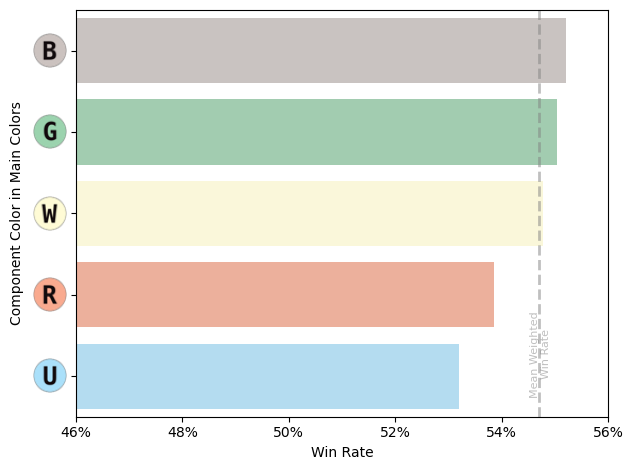
Figure 7 shows the win rates for the five primary colors, based on whether they serve as a main component in a deck. For example, the “B” results reflect the win rates for Black in decks such as WB, BG, Mono-Black, and UBR.
The decks using black perform the best, with ones using blue performing the worst.
3.3 Win Rate over Time
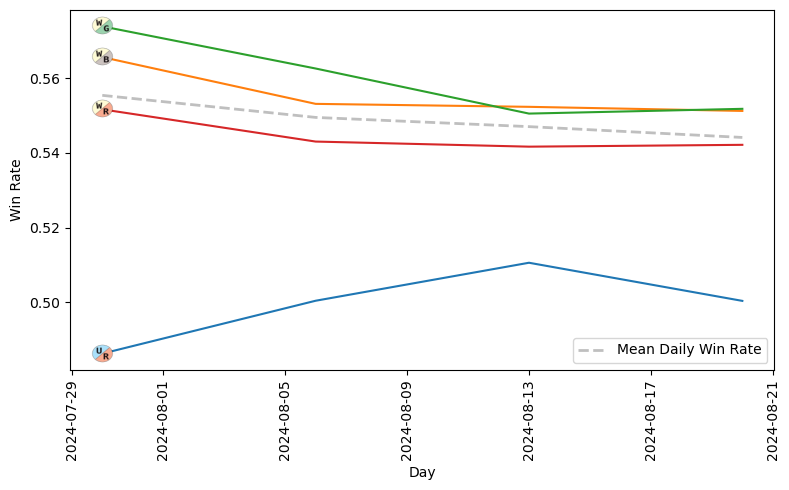
It’s also insightful to observe how the win rates for two-color decks evolve over time. I selected the four decks with the largest absolute changes in win rate between the start and end of the period. In Figure 8, we see that the White-Green, White-Black, and White-Red had higher win rates initially, but they slowly declined. The Blue-Red deck conversely improved in the win rate over time.
3.4 Color Freq vs Win Rate
Next, let’s compare the use rate to the win rate to see if the player base is well-calibrated in their deck selections based on performance.
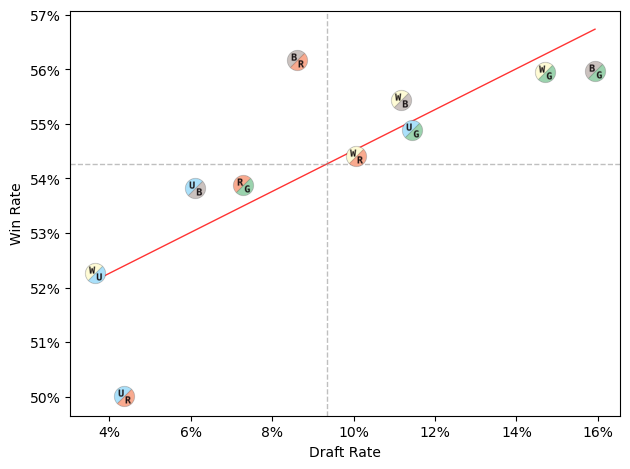
In Figure 9, we observe that most of the two-color decks align along a straight line, indicating a balanced relationship between use rate and win rate, with two notable outliers. The Blue-Red Otters: Non-creature Spells deck underperforms relative to its use rate, suggesting it may be over-selected. In contrast, the Black-Red Lizards: Opponents Lose Life deck is a hidden gem, boasting the highest win rates but being picked less frequently than the average two-color deck.
This under-selection of Black-Red likely stems from the general underperformance of Red, leading many drafters to avoid it unless they secure strong Black-Red cards early. On the other hand, White, Green, and Black perform well, making the BG, WG, and WB decks popular and flexible choices that players can easily pivot to during drafts.
3.5 Wedges vs Shards
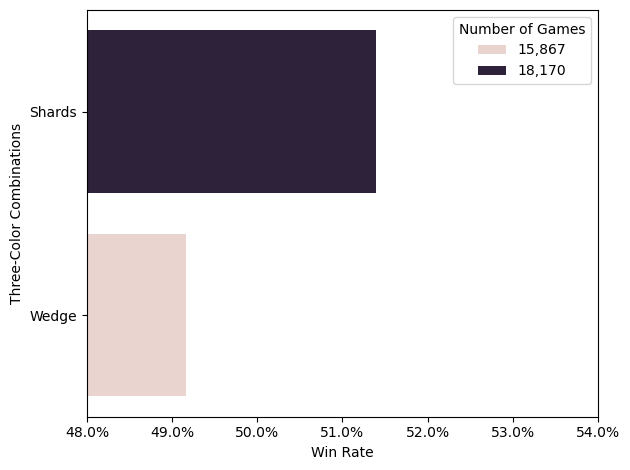
Magic: The Gathering color theory includes five wedges and five shards. Wedges are three-color decks built around a primary color and its two allies, while shards consist of a primary color and its two enemies. Conventional wisdom suggests that wedges are generally easier to draft than shards.
However, as shown in Figure 10, the shards have a slightly higher win rate and use rate compared to the wedges. The BLB set has the highest gap between the two groups, with the other sets having a <1% spread.
4 Opposing Player Colors
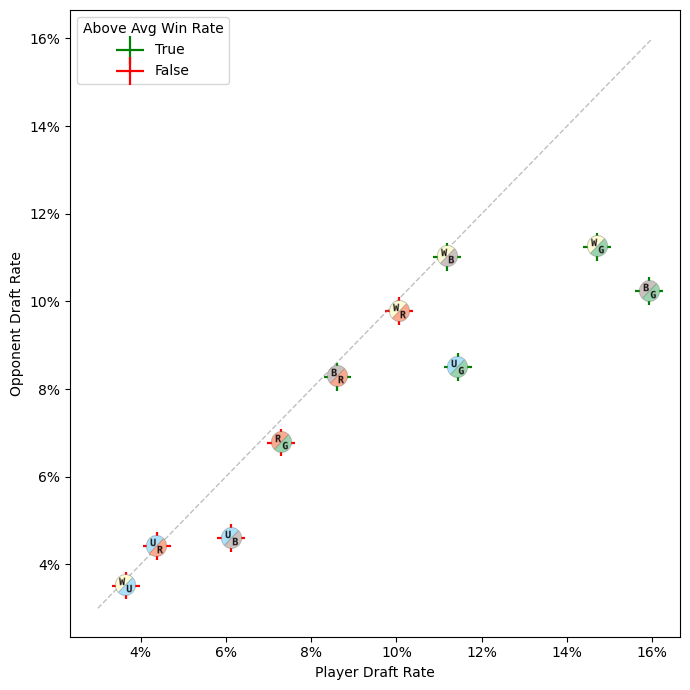
We also have data on the opposing player colors, which helps us understand the draft meta. For each draft color combination, we compare the use rate of 17Lands players with that of their opponents. Each combination is color-coded to indicate whether its win rate is above or below the average win rate of the 17Lands player base. A diagonal grey line is included to show parity between the use rates of 17Lands players and the general player base.
In Figure 11, we focus on the two-color drafts. The data reveals that White-Green (WG), Black-Green (BG), and Blue-Green (UG) decks are more favored by 17Lands players and also boast higher win rates. Conversely, the Blue-Black (UB) deck is favored but has a significantly lower win rate. The other color pairs show parity between the two player bases.
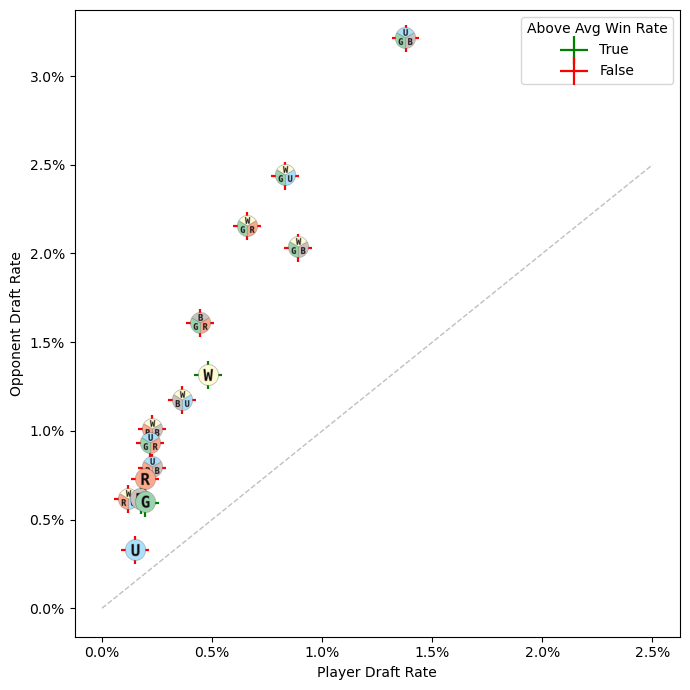
Looking at the non-2-color drafts in Figure 12, we observe that 17Lands players are far less likely to draft any color combination that isn’t a two-color deck. These non-2-color decks generally have lower win rates, with some exceptions in the mono White, Green, and Black decks.
This suggests that if a player is drafting mono White, Green, or Black, they may be better off staying mono rather than adding Blue or Red to create a two-color deck. However, since mono decks are drafted so infrequently, their strong performance might be circumstantial, depending on specific card combinations, and may not represent a consistent advantage across the entire color set.
5 Color Face-Offs (2-Color vs 2-Color)
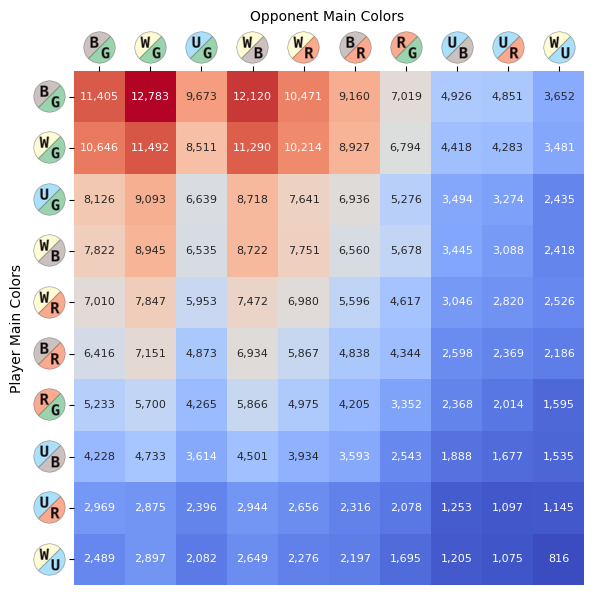
Let’s now compare each pairing of the two-color decks in Figure 13. This comparison provides insights into the strengths and weaknesses of individual decks.
We start by examining the number of games played between each pairing. The rows and columns are sorted by the maximum frequency of player deck pairings, with Black-Green (BG) vs. White-Green (WG) being the most frequent, followed by WG vs. WG matchups. The average number of games played between each pairing is 5,031.
As noted earlier, 17Lands players draft BG, WG, and Blue-Green (UG) decks more frequently than their opponents, while the other color pairs are used at near parity.
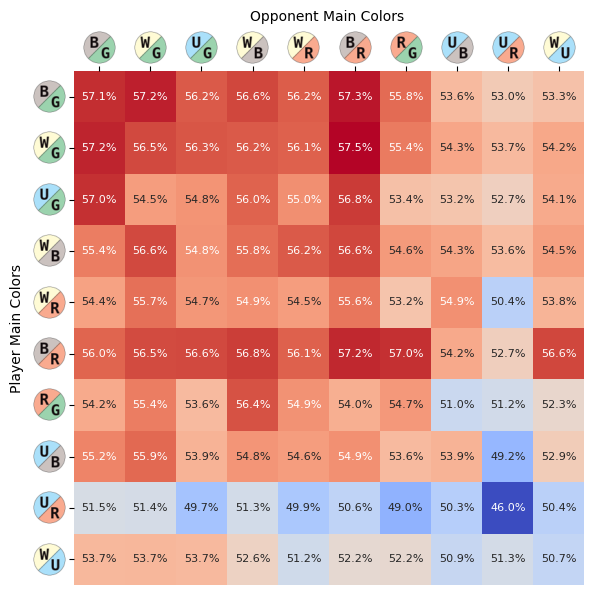
Next, we examine the pair-wise win rates for players in Figure 14.
The most notable observation is that the 17Lands player base performs well in most matchups, with a significant exception for the Blue-Red (UR) deck. On average, UR matchups underperform by about 4 percentage points compared to similar matchups. Notably, the UR vs. UR matchup is exceptionally low and is the only like-paired matchup with win rates below 50%, indicating less than even odds of winning.
6 Color Splash
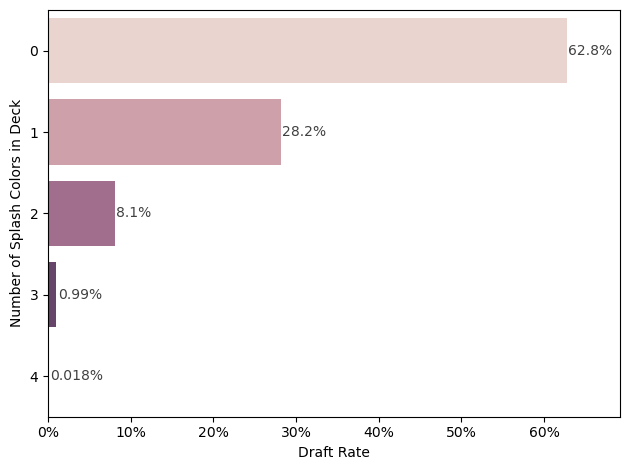
Splash colors are 1-3 non-land spell cards of a given color that enhance a deck without significantly diluting its main colors. These splash cards are often very powerful and can provide strategic advantages.
In Figure 15, we can see how frequently splashing occurs across different decks.
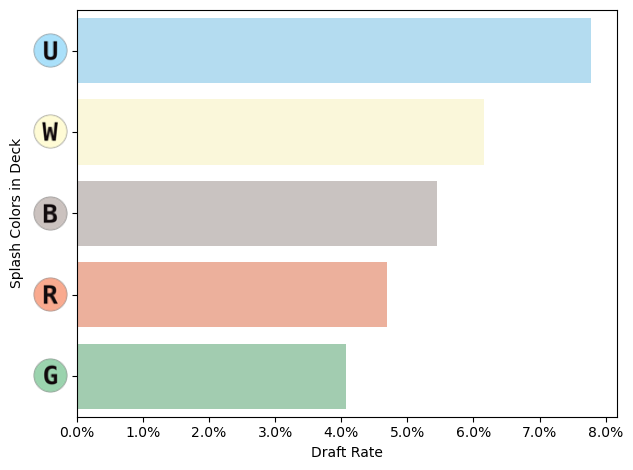
In Figure 16, we observe the frequency of splashing for each color. Blue is the most commonly splashed color, while Green is the least common. In all sets analyzed, Green is the least common splash color.
7 Conclusion
This analysis of the Bloomburrow (BLB) draft data provides valuable insights into the dynamics of deck performance, player strategies, and overall gameplay within the set. Key findings include the strong influence of deck choice on win rates. We observed that players often align closely with expected use rates and win rates, but there are some exceptions. Ultimately, understanding these patterns can help players refine their drafting and gameplay strategies, making more informed decisions to enhance their success in both digital and paper formats.